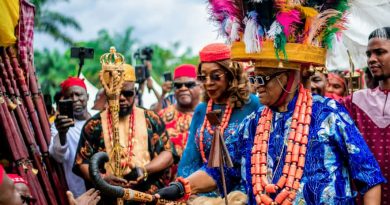
FG Denies ‘Ezeigbo Installation’ in South Africa, Says Title Is Purely Cultural

…Insists ‘Igwe Ndigbo East London’ Has No Political or Territorial Authority
By Brown Chimezie,
The Federal Government has dismissed reports alleging the installation of an “Igwe Ndigbo” in East London, South Africa, clarifying that no coronation took place and none was intended.
The Nigerian High Commission in Pretoria, South Africa, made the clarification in a statement while reacting to reports surrounding the purported installation of an individual as “Igwe Ndigbo na East London” (King of the Igbo people in East London) by members of the Nigerian community in the country.
The Mission said it had taken note of concerns expressed by South African authorities, particularly traditional leadership structures, as well as members of the public over the development.
According to the High Commission, the matter had generated understandable concern, especially in view of South Africa’s legal and cultural frameworks governing traditional leadership.
“The High Commission wishes to state, unequivocally, that, contrary to the narrative in the public domain, no coronation took place and none was intended,” the statement said.
It added that the Federal Republic of Nigeria holds the sovereignty, laws, customs and traditions of the Republic of South Africa in the highest regard.
“Nigeria deeply values the longstanding bilateral relations between both countries, which are anchored on mutual respect, cooperation and a shared commitment to African unity and development.
“It is in this light that the earlier live television interview by our Head of Mission, reiterating Nigeria’s commitment to respecting the host country’s laws and customs, should be understood,” the Mission stated.
The High Commission further explained that Nigeria is a multi-ethnic country made up of diverse nationalities, with the Hausa, Yoruba and Igbo as the three major ethnic groups.
It noted that cultural festivals and title-taking ceremonies are central to Igbo identity and communal life.
Among such traditions, the Mission listed the New Yam Festival (Iri Ji), masquerade festivals (Mmanwu), traditional marriage ceremonies (Igba Nkwu) and chieftaincy title-taking ceremonies, all of which it described as important expressions of history, spirituality and social cohesion.
The Mission said the event in East London should be understood within this broader cultural context and not as an attempt to establish any form of political authority.
“It is important to emphasise that the event in East London has no territorial ambition, political authority or agenda within the host communities.
“Rather, it is a symbolic affirmation of identity — an expression of pride in heritage and a commitment to sustaining cultural practices across borders,” the statement added.
While expressing regret over any misunderstanding or offence the development may have caused, the High Commission appealed for understanding, stressing that there was no intention to undermine or disrespect South African traditional institutions or the laws of the Republic.
It also called for calm and restraint among all stakeholders.
Ohanaeze Ndigbo South Africa Refutes ‘Kingdom’ Claims
Meanwhile, Ohanaeze Ndigbo South Africa (ONSA) has also refuted what it described as misleading publications suggesting that the Igbo community in East London established a sovereign kingdom and crowned a king.
In a disclaimer jointly signed by its President, ABC Okokoh, and General Secretary, L. K. Ashinze, the group described the reports as false and harmful.
According to the organisation, the misinformation had been amplified by certain individuals and groups seeking social, commercial and political relevance at the expense of peace, cohesion and integration.
“We wish to categorically refute these misleading publications and provide an accurate account of the event in question,” the statement said.
The group explained that Ohanaeze Ndigbo is the apex socio-cultural organisation of the Igbo people worldwide, with its headquarters in Enugu, Nigeria, and diaspora chapters across the globe.
It said Ohanaeze Ndigbo South Africa serves as the South African chapter and exists to preserve and promote Igbo culture, heritage and collective interests.
Clarifying the use of the title “Igwe,” the group said the term in Igbo language literally means “the heaven” or “the sky,” and is often used to describe a person of high standing, influence or achievement.
According to ONSA, in the diaspora context, the title simply denotes a cultural leader and does not imply monarchy, kingship or sovereignty.
“For ONSA, it denotes a cultural leader, an honourable elder and a custodian of Igbo values.
“In the diaspora context, we use it to refer to an Igbo cultural leader, which does not imply the creation of a monarchy or any claim to sovereign territory,” it stated.
The group said that on March 14, 2026, the Igbo community in East London gathered solely for the inauguration of a community leader, honourarily addressed as “Igwe.”
It said the individual’s role is to promote unity among Igbos, preserve cultural identity, mentor the younger generation, encourage peaceful coexistence and foster integration with host communities.
According to the statement, the office is meant to serve as a rallying point for community building and cultural continuity, particularly for Igbo children and youths living abroad.
“His responsibilities include the promotion of our culture, traditions, customs and heritage — Igbo history, language, food, costume, libation, folklore, music and dance.
“He also provides representation for the Igbo community, mentors our people on how to live in harmony with host communities, and advises them on the need to respect the laws of the host country,” the group said.
‘No Kingdom Was Established’
The organisation stressed that no king was crowned and no kingdom was created in East London.
“For the record, ONSA did not crown a king for East London.
“We did not establish a kingdom in East London. We simply created a cultural rallying point for Igbo people in the area through the election and inauguration of someone to lead the community,” the statement said.
It lamented that the development had been deliberately misconstrued, sensationalised and politicised by individuals intent on creating tension between the Igbo community and host communities in South Africa.
ONSA also cited its longstanding relationship with South African traditional institutions as evidence of its respect for the country’s cultural systems.
The group recalled its previous engagements with the late King Mpendulo Zwelonke Sigcawu of the AmaXhosa, King Bhungane III of the Embo Kingdom and AmaHlubi, and the late King Goodwill Zwelithini kaBhekuzulu of the AmaZulu.
According to the organisation, those interactions were part of broader efforts to promote cultural exchange, social cohesion and integration between Igbos and South Africans.
“These instances show that the Igbo people in South Africa are 100 per cent loyal and subject to the traditional institutions and kingships of South Africa, and not otherwise,” the statement added.
The group reiterated that the Igbo community in South Africa has neither established nor intends to establish any parallel kingship structure.
“For purposes of emphasis and clarity, we wish to state unequivocally that the Igbo community in South Africa has not established, does not intend to establish, and will never establish parallel kingdoms or kings in South Africa.
“We are guests in this great nation. Our ancestral homeland is in Igboland. We hold the sovereignty of the Republic of South Africa and its traditional institutions in the highest regard,” ONSA stated.
The organisation appealed to South Africans and the wider public to disregard what it described as inflammatory misinformation being spread by persons bent on sowing division and fuelling xenophobic sentiments.
It reaffirmed the commitment of the Igbo community in South Africa to peaceful coexistence, cultural exchange, social integration and mutual respect with host communities.
“The Igbo community in South Africa remains committed to the pursuit of social integration and cohesion, cultural exchange and peaceful coexistence, as well as a mutually respectful and beneficial relationship with South African communities and all other communities in the country,” the statement concluded.