NALW: Media Expert visits Executive Secretary
…Hails Nwawuba’s contributions towards digitization of legislative records
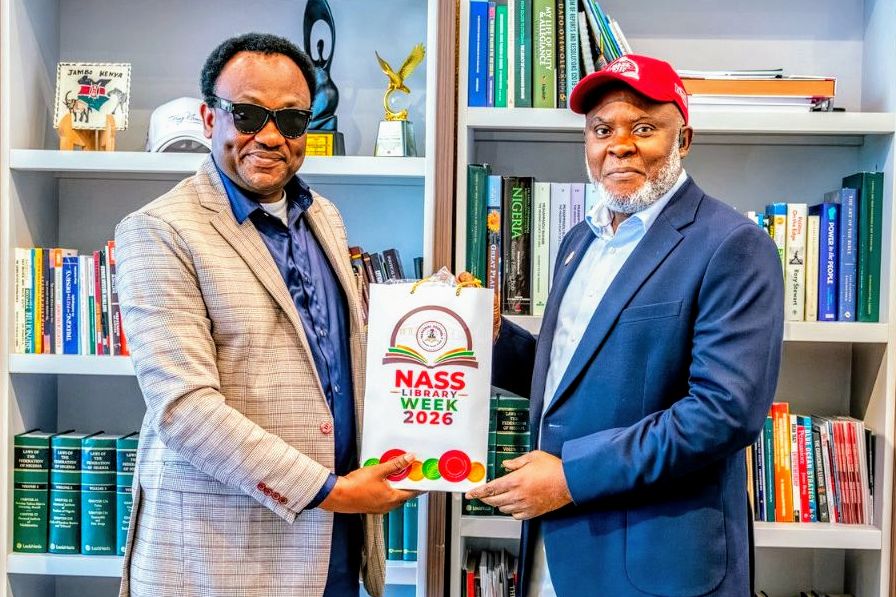
On Thursday, October 8, 2026, Rt. Hon. Henry Nwawuba received Chief Njoku Macdonald Obinna, Publisher of 4th Estate Reporters, at the National Assembly Library in Abuja, where discussions centred on the importance of preserving Nigeria’s legislative history, promoting knowledge sharing and strengthening the relationship between public institutions and the media for strategic collaboration.
The visit provided an opportunity for both men to discuss the vision behind the National Assembly Library Week and the role of institutions in preserving knowledge, encouraging constructive dialogue and making Nigeria’s democratic heritage accessible to future generations. Obinna also explored the Legislative Museum, which houses collections reflecting the history of the Nigerian legislature and the country’s democratic journey.
In his remarks following the meeting, Nwawuba expressed pleasure at receiving the media practitioner and commended his efforts through 4th Estate Reporters to advance journalism and public discourse. He described Njoku Macdonald Obinna as a distinguished son of Imo State who has made significant contributions to the media industry.
The visit highlighted the importance of preserving the records and experiences that have shaped Nigeria’s democratic institutions. The National Assembly Library serves as an important resource for legislative information, historical documentation and research, providing opportunities for journalists, scholars, students and members of the public to gain a deeper understanding of the country’s parliamentary development.
The engagement also comes in the wake of the 2026 National Assembly Library Week, held from September 28 to October 1, which focused attention on the importance of parliamentary records, legislative knowledge and public access to information. Such initiatives reinforce the need to preserve institutional history and ensure that the experiences of previous generations remain available to inform present decisions and future policies.
For journalists, access to reliable historical records is essential to responsible reporting. Beyond breaking news and daily political developments, professional journalism requires a clear understanding of the institutions, policies and historical circumstances that shape public affairs. The availability of credible information helps journalists provide context, challenge misinformation and present issues in ways that enable citizens to make informed decisions.
Speaking on the significance of the visit, Nigeria Media Expert, Public Affairs Analyst and Publisher of 4th Estate Reporters, Njoku Macdonald Obinna, expressed appreciation to Rt. Hon. Henry Nwawuba for the warm reception and the opportunity to learn more about the work of the National Assembly Library Trust Fund and its contribution to preserving Nigeria’s legislative heritage.
Njoku Macdonald Obinna noted that the preservation of national history is a responsibility that should not be taken for granted, stressing that a nation’s understanding of its present and its preparation for the future depend, to a considerable extent, on how well it documents and protects its past.
He observed that the media has an important responsibility to communicate the activities of public institutions accurately and responsibly, while ensuring that citizens have access to information that promotes understanding, accountability and constructive public participation.
According to him, meaningful engagement between the media and public institutions can contribute to a better-informed society when built on professionalism, mutual respect and a shared commitment to the public interest. He also emphasised that journalists must continue to uphold the principles of accuracy, fairness and independence in carrying out their duties.
Njoku Macdonald Obinna further expressed appreciation for Nwawuba’s commendation of his work through 4th Estate Reporters, describing the encouragement as a reason to remain focused on responsible journalism and the promotion of issues that matter to society. He reaffirmed his commitment to using the platform to report developments in governance, public affairs and national development while maintaining the standards expected of a credible media organisation.
The exploration of the Legislative Museum added historical significance to the visit, offering an opportunity to reflect on the people, records and events that have contributed to Nigeria’s democratic evolution. Such collections serve as reminders that the work of documenting national history extends beyond preserving old records; it also involves ensuring that future generations can learn from the experiences, decisions and challenges that shaped the country.
The meeting between Nwawuba and Obinna underscores the continuing relevance of knowledge, historical preservation and responsible journalism in a democratic society. As public institutions work to preserve the nation’s legislative heritage, the media remains an important channel through which citizens can understand the significance of those efforts.
For 4th Estate Reporters, the visit reinforces the importance of professional engagement with institutions whose work contributes to governance, education and national development. It also reflects the value of creating opportunities for dialogue and knowledge sharing in the collective effort to build a society that understands its history, values credible information and remains committed to democratic progress.